Search
Search for "click":
(Click here to search this entire website for "click" with Google.)
 |

|
|
Analog MUX 2 Click is a compact add-on board that switches one of the eight inputs to one output. This board features the ADG728, a low voltage, CMOS 8-channel analog matrix switch with a serially controlled 2-wire interface from Analog Devices. The ADG728 can operate equally well as either multiplexer, demultiplexer, or switch array easily connected to a 9 pole spring action block terminal. It provides flexibility and features a low on-resistance closely matched between switches and very flat over the full signal range. This Click board™ is suitable for a wide range of applications, from industrial and instrumentation to medical, consumer, communications, and automotive systems.
Analog MUX 2 Click is supported by a mikroSDK compliant library, which includes functions that simplify software development. This Click board™ comes as a fully tested product, ready to be used on a system equipped with the mikroBUS™ socket.
|
|
|
|
|
|
|
|
Analog MUX 3 Click is a compact add-on board that switches one of the eight inputs to one output. This board features the ADG738, a CMOS analog matrix switch with a serially-controlled SPI interface from Analog Devices. In an active state, the ADG738 conducts equally well in both directions, making it suitable for multiplexing and demultiplexing applications. It can also be configured as a type of switch array where any, all, or none of eight switches may be closed any time. All channels exhibit ‘break-before-make switching action, preventing momentary shorting when switching channels. This Click board™ is suitable for a wide range of applications, from industrial and instrumentation to medical, consumer, communications, and automotive systems.
Analog MUX 3 Click is supported by a mikroSDK compliant library, which includes functions that simplify software development. This Click board™ comes as a fully tested product, ready to be used on a system equipped with the mikroBUS™ socket.
|
|
|
|
|
|
|
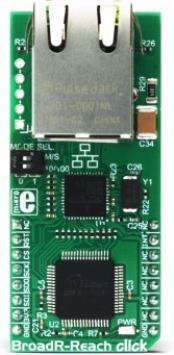
BroadR-Reach click brings the industry grade communication standard to the mikroBUS™, which is built to be used in an Ethernet-based open network. The click board is equipped with the BCM54811 Transceiver from Broadcom Limited, which is used to provide the hardware PHY layer for the network, and the W3150A+ from WizNet, a hardware LSI protocol stack, that provides an easy and low-cost solution for high-speed Internet connectivity for digital devices by allowing simple installation of TCP/IP stack in the hardware.
BroadR-Reach® point-to-point Ethernet PHY technology was developed by Broadcom Limited. BroadR-Reach® technology is a robust Ethernet physical layer interface, designed for use in noisy environments and harsh conditions, such as in industrial networking applications. This technology allows multiple systems to simultaneously access information over the unshielded single twisted pair cable, reducing connectivity costs and cabling weight. As such, it offers a great alternative to older, rather limited standards used so far, and enables faster data rates to be transferred over the existing cable networks. |
|
|
|
|
|
|
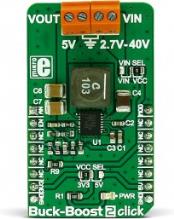
Buck-Boost 2 click is an advanced DC-DC step-down/step-up regulator (buck/boost), which is able to provide regulated 5V on its output, regardless of the input voltage. The input voltage can range from 2.7V up to 40V. The Click board™ provides an ultra-low noise and ripple free regulated output, with transparent switching from buck to boost mode - depending on the input voltage, which produces no discontinuities or switching artifacts, such as transients or subharmonic switching. Selectable switching mode allows optimal power consumption and high power efficiency, for both lighter and heavier loads. |
|
|
|
|
|
|
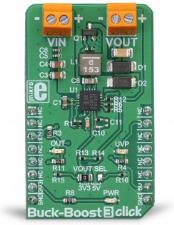
The Buck-Boost 3 click is a voltage converter/regulator, which is able to provide a regulated voltage of 3.3V or 5V on the output, even when the input voltage drops under 3V. This is possible thanks to the ISL85403, a specialized buck-boost voltage converter IC which features an integrated high-side MOSFET and a low-side driver, that can be used to drive an external MOSFET. Buck-Boost 3 click perfectly suited to provide power with regulated voltage for embedded applications, points of load, or to be used as the battery voltage regulator, or in similar general-purpose power applications that require regulated 3.3V or 5V power supply.
It comes in the package which also includes the mikroSDK™ software and a library with all the functions. The Click board™ comes as a fully tested and approved prototype, making it a reliable device ready to use on the development board.
|
|
|
|
|
|
|
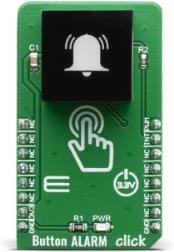
Button ALARM Click is a very interesting interactive gadget on a Click board™. It is an integrated capacitive touch sensor display in the form of a button. By utilizing an advanced capacitive touch sensing technology, the CTHS15CIC05ALARM sensor can successfully replace the traditional mechanical button, allowing very simplified yet reliable user interfaces to be developed. Besides the touch detection, this sensor also features a green power symbol icon with backlight, which makes the Click board™ very useful for building various stylized and visually appealing interfaces.
The Click board™ is supported by the mikroSDK compliant library, which includes functions that simplify software development. The Click board™ comes as a fully tested product, ready to be used on a system equipped with mikroBUS™.
|
|
|
|
|
|
|
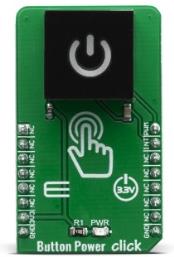
Button Power Click is a very interesting interactive gadget on a Click board™. It is an integrated capacitive touch sensor display in the form of a button. By utilizing an advanced capacitive touch sensing technology, the CTHS15CIC05ONOFF sensor can successfully replace the traditional mechanical button, allowing very simplified yet reliable user interfaces to be developed. Besides the touch detection, this sensor also features a green power symbol icon with backlight, which makes the Click board™ very useful for building various stylized and visually appealing interfaces.
The Click board™ is supported by the mikroSDK compliant library, which includes functions that simplify software development. The Click board™ comes as a fully tested product, ready to be used on a system equipped with mikroBUS™.
|
|
|
|
|
|
|
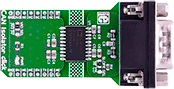
CAN Isolator click provides isolated CAN communication. It carries the ADM3053 signal and power isolated CAN transceiver with an integrated isolated DC-to-DC converter. The click is designed to run on either 3.3V or 5V power supply. CAN Isolator click communicates with the target microcontroller over UART interface. |
|
|
|
|
|
|
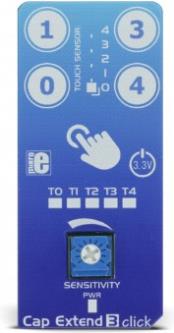
Cap Extend 3 click features four capacitive sensor pads integrated on the PCB, that can sense touch through a variety of different materials. This click can sense touch through plastic, wood, or even metal, thanks to the proprietary Metal over Capacitive technology. All these materials can be used to protect the surface of the PCB and sensor pad traces, allowing implementation of all kinds of human-machine interfaces and seamless integration of the touch-sensitive buttons into various kinds of front panels. The click also features a connector used for connecting to external sensors.
Features like the multi-stage active noise suppression filtering, automatic environmental compensation, high signal-to-noise ratio (SNR) and support for a wide range of sensor pad shapes and sizes, allow this device to be used as a reliable replacement for buttons or switches in many applications, including light switches, office equipment and toys, display and keypad backlight activation, and similar applications where a reliable and aesthetically pleasing button alternative is required. |
|
|
|
|
|
|
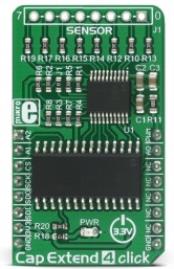
Cap Extend 4 click provides a unique opportunity to control digital devices by using a variety of physical objects. This click adds touch/proximity detection feature to any application, providing an easy and intuitive framework for building a human-machine interface. The click can be connected to eight different sensors, which can sense touch/proximity through a number of various materials, such as wood, plastic or even metal, thanks to Microchip's proprietary Metal over Capacitive technology.
Cap Extend 4 click can be used for building human-machine interfaces for various touch activated applications, such as light switches, toys and office equipment, device activation via the PCB touch buttons, and other innovative and interesting ways of touch control. |
|
|
|
|
|
<< First
< Previous
Next >
|
|